
Understand federal employee benefits and beneficiaries: FEGLI group life insurance, Thrift Savings Plan (TSP), and divorce. Learn key beneficiary facts.
Top Beneficiary Facts for Federal Employees: FEGLI Life Insurance Death Benefit Payout, TSP, and Divorce
This article aims to provide clarity for several key topics regarding benefits payable upon death to the surviving family members and beneficiaries of federal employees and retirees. These include:
- The death benefits provided by Basic FEGLI coverage, as well as optional coverage A, B, and C.
- The importance of keeping TSP beneficiary records current.
- How divorce can impact federal employee retirement benefits, including FEGLI benefits.
Need to start planning for retirement? Attend a Free Federal Retirement Webinar.
Understanding FEGLI Death Benefits, Beneficiaries, and Payout Claims
For federal employees and retirees, the Federal Employee Group Life Insurance (FEGLI) program offers a structured safety net, one that can provide meaningful financial support to loved ones in the event of death. Here’s a clear breakdown of how much coverage each individual policy provides, how beneficiary designation works, and a timeline for when benefits are paid.
Basic Life Insurance Coverage Provided by Group Life Insurance Program for Federal Workers
In order to have any optional FEGLI policies, employees must be enrolled in FEGLI Basic.
- Automatic Enrollment – All eligible federal employees are automatically enrolled in FEGLI basic unless they opt out, which can be done at anytime. To add insurance, however, there must be a qualifying life event (such as marriage or divorce), a medical examination (like with many private term life insurance policies), or during a (very rare) FEGLI open season (last one occurred in 2016).
- Death Benefit Amount – Called the Basic Insurance Amount (BIA) is calculated as:
- Your annual basic pay (rounded up to the next $1,000)
- Plus $2,000
- Example: If your salary is $52,500, your BIA would be $55,000 ($53,000 + $2,000).
- Extra Benefit for Younger Employees – If you’re under age 45, Basic coverage includes an Extra Benefit:
- Age 35 and under: Death benefit is doubled
- Ages 36–44: Benefit decreases by 10% each year until it equals the BIA at age 45
- Accidental Death and Dismemberment (AD&D) – Basic coverage includes AD&D benefits:
- Pays an additional amount equal to the BIA for accidental death
- Partial payouts for loss of limbs or eyesight
Optional Coverage: Standard and Additional Insurance, plus Option C for Family Members
Enrollment in optional insurance is not automatic. There are three types of optional insurance plans and the cost of any optional insurance from the federal group term life insurance program is dependent on age and can be canceled at any time.
| Forms of Optional Insurance | Coverage Amount | Cost of Insurance Option | Notes | In Retirement |
| Option A (Standard) | Provides an additional $10,000 in life insurance. | Premiums are age-based and fully paid by the employee. | Ideal for those seeking a modest supplement to Basic coverage, especially helpful for final expenses or small debts. | Like with Basic, reduced coverage (25%) can be kept after retiring at no additional cost |
| Option B (Additional) | Lets you choose 1 to 5 multiples of your annual basic pay. | Premiums increase with age and are fully paid by the employee. (Very expensive with older age) | This is the most customizable option, allowing employees to scale coverage based on family size, debt, or financial goals. | Must be kept in full or completely dropped when retiring from federal service. |
Option C (Family) | Provides life insurance for your spouse and eligible dependent children: Spouse: $5,000 per multiple (up to 5 multiples, $25,000 max) / Child: $2,500 per multiple (up to 5 multiples, $12,500 max per child) | Premiums are based on your age and number of multiples selected. | Designed to help cover funeral costs or short-term financial needs for surviving family members. | In some cases, a refund of FEGLI Option C premiums can be paid back if no eligible family members were being covered at the time. Coverage for your spouse can continue in retirement, and until child reached age 22 (unless disabled) |
Get a Free FERS Handbook when you subscribe to our Newsletter.
Beneficiaries Guide for Claiming FEGLI Death Benefits and Insurance Payout Timeline
When a federal employee or retiree covered under the FEGLI insurance program dies, the death benefit is paid to the person or entity designated as the beneficiary on the insured’s FEGLI records.
- Primary Beneficiaries: These are the individuals or entities (like a trust or estate) named by the insured to receive the benefit first.
- Contingent Beneficiaries: If no primary beneficiary is alive or eligible, the benefit goes to the contingent beneficiaries, if any were named.
- No Designation on File: If no valid beneficiary designation exists, benefits are paid according to a standard order of precedence:
- Widow or widower
- Children (in equal shares)
- Parents
- Executor or administrator of the estate
- Next of kin
To claim the FEGLI death benefit, the beneficiary must complete Form FE-6 and submit it along with a certified copy of the death certificate. Upon the death of the insured, the Office of Federal Employees’ Group Life Insurance (OFEGLI) pays out benefits to designated beneficiaries. Here is a timeline for the process:
- Death Occurs: The insured federal employee passes away. Beneficiaries should be notified and prepared to file a claim.
- Life Insurance Claims Initiation: Beneficiary completes and submits Form FE-6 (Claim for Death Benefits) to begin request for insurance payout. Supporting documents required:
- Certified death certificate
- Proof of identity
- Any additional documentation requested by OFEGLI
- Claim Processing Begins: OFEGLI (administered by MetLife) begins processing once all documents are received, Typical processing time: up to 30 days from receipt of complete claim.
- Payment Method Determined – If the benefit is under $5,000: paid via check. If $5,000 or more: beneficiary chooses between: Check or MetLife Total Control Account (TCA), an interest-bearing account automatically set up if no choice is made.
- Life Insurance Proceeds Funds Disbursed – Once approved, funds are released to the beneficiary. Most beneficiaries receive payment within 30–60 days of filing, depending on claim completeness and verification speed.
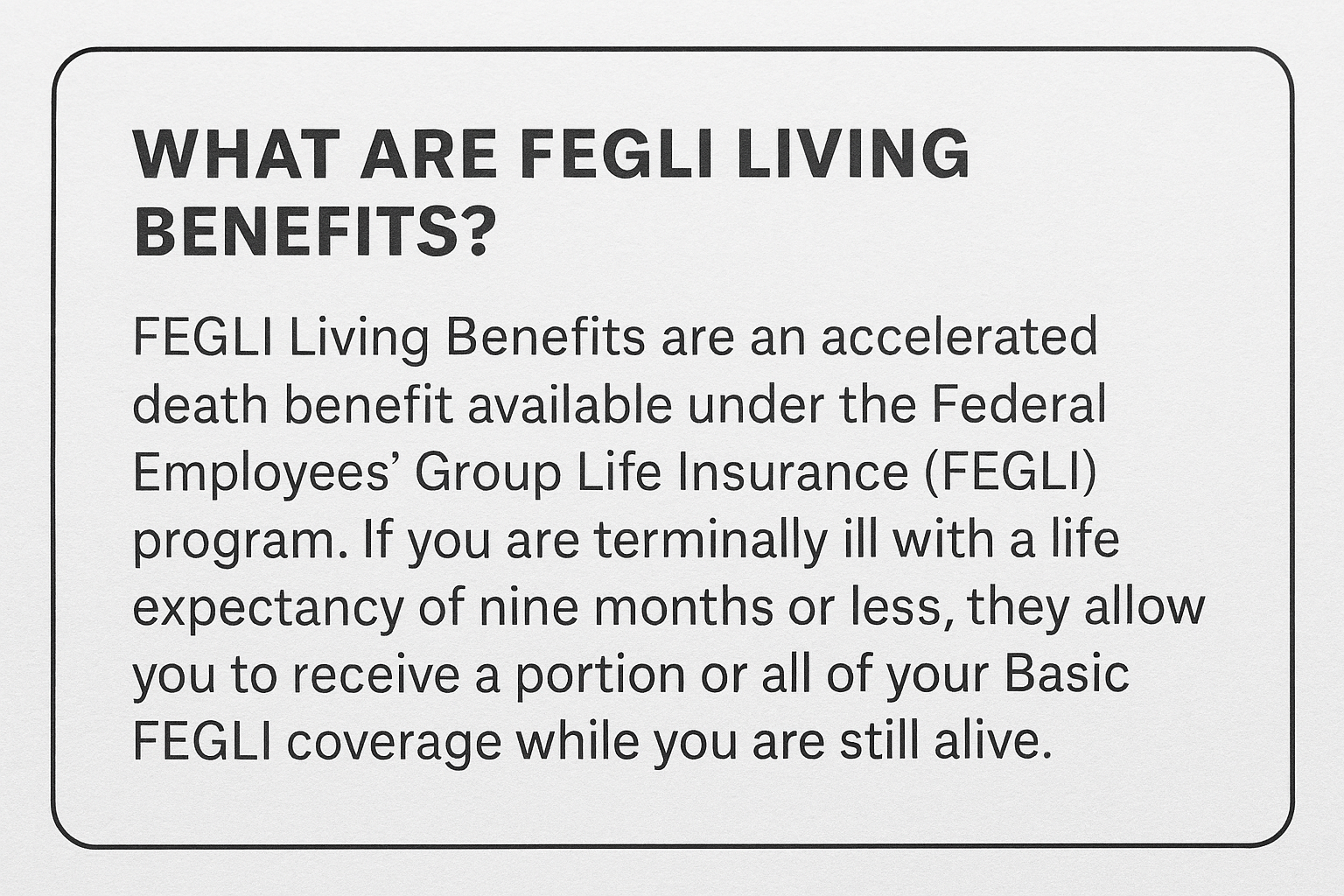
Speak with a financial advisor for federal employees to determine if a private insurance policy or the life insurance benefits provide by FEGLI best suit your retirement goals. Schedule a free consultation here.
Beneficiary Information for Thrift Savings Plan Participants and Why You Must Keep Them Updated
When it comes to retirement planning, few details are as deceptively simple, and potentially devastating, as your beneficiary designations. For federal employees, keeping your beneficiary information current isn’t just good housekeeping. It’s a legal safeguard that can determine whether your loved ones receive your retirement savings, or face a costly, emotional mess.
The Risk and Consequences of Outdated Beneficiaries
TSP pays death benefits strictly according to the beneficiary designation on file at the time of death. That means:
- Your will doesn’t override your TSP form
- Life changes (divorce, remarriage, death of a beneficiary) don’t automatically update your records
- If no designation is on file, TSP follows a statutory order of precedence:
- Spouse
- Children
- Parents
- Executor of estate
- Next of kin
This order may not reflect your wishes, and it can lead to legal disputes, delays, or unintended outcomes. Imagine this: a federal employee divorces and remarries but forgets to update their TSP beneficiary. Years later, they pass away and their ex-spouse receives the entire account. The new spouse, children, or intended heirs? Legally left out. And TSP cannot honor verbal instructions, wills, or court orders that contradict the form on file.
How to Update Your Beneficiaries for the Federal Savings Plan
Updating your beneficiaries is simple, but must be done correctly:
- Log in to your online account at TSP.gov
- Complete or revise Form TSP-3
- Designate primary and contingent beneficiaries
- Review and update after any major life event:
- Marriage or divorce
- Birth or adoption
- Death of a beneficiary
- Change in financial priorities
You can designate up to 20 beneficiaries, including individuals, trusts, charities, or your estate. This is a key planning checkpoint. Employees are encouraged to review beneficiary forms annually. A five-minute update can prevent years of regret. Your thrift account might be one of your largest financial assets. Don’t let outdated paperwork decide its fate. Keeping your beneficiary designations current is one of the simplest, most powerful ways to protect your legacy.
Read this article about TSP Inheritance Rules
Federal Employee Benefits and Divorce: Other Key Facts
Divorce is never just emotional, it’s logistical. For federal employees, it’s also bureaucratic. When a marriage ends, your benefits don’t automatically update to reflect your new reality. And if you don’t take action, your ex-spouse could receive survivor benefits you never intended, or your current partner could be left with nothing.
FERS Survivor Benefits: Court-Ordered and Complex
The Federal Employees Retirement System (FERS) provides survivor benefits to spouses if elected, but divorce changes the game.
- A Court Order Acceptable for Processing (COAP) can require you to provide a survivor annuity to your ex-spouse, even after divorce.
- If no COAP is filed, your ex-spouse loses eligibility unless you voluntarily elect a survivor benefit for them.
- If you remarry and don’t update your election, your new spouse might be ineligible for survivor benefits.
Key Action: Review your retirement paperwork and submit a new election after divorce or remarriage. Survivor benefits are not automatic and must be actively managed.
Social Security Spousal Survivor Benefit: Federally Governed, Not Divisible
Unlike FERS, Social Security is governed by federal law and cannot be divided in a divorce decree. But your ex-spouse may still qualify for survivor benefits if:
- You were married for 10 years or more
- They are unmarried and age 60 or older (or 50 if disabled)
- They are not receiving a higher benefit based on their own work record
Important Note: You don’t need to take action for your ex to receive these benefits. They apply automatically if eligibility is met. There is also spousal survivor supplement benefit if the widow or widower of a federal employee is under the age of 60.
FEGLI: Life Insurance That Follows the Form
The FEGLI program pays out based on the beneficiary form on file, not your will or divorce decree.
- If your ex-spouse is still listed, they’ll receive the payout—even if you’ve remarried.
- FEGLI does not honor verbal instructions or court orders that contradict the form.
Key Action: Submit a new SF-2823 form after divorce. This is the only way to change your FEGLI beneficiary.
Retirement Savings That Can Be Frozen or Divided
Your Thrift Savings Plan account is considered marital property and can be divided during divorce via a Retirement Benefits Court Order (RBCO).
- A valid RBCO can freeze your account until the division is complete.
- TSP pays out death benefits based on the beneficiary form on file, not your will or divorce decree.
- If no form is on file, TSP follows a statutory order of precedence.
Key Action: Update your TSP-3 beneficiary form and consult legal counsel if a RBCO is issued.
Final Checklist for Federal Employees Facing Divorce
- [ ] Submit a new FEGLI beneficiary form (SF-2823)
- [ ] Update your TSP-3 beneficiary form
- [ ] Review and revise FERS survivor benefit elections
- [ ] Understand Social Security eligibility for ex-spouses
- [ ] Consult with a federal benefits specialist or attorney
Reach Out to Us!
If you have additional federal benefit questions, contact our team of CERTIFIED FINANCIAL PLANNER™ (CFP®), Chartered Federal Employee Benefits Consultants (ChFEBC℠), and Accredited Investment Fiduciary (AIF) professionals. At PlanWell, we are federal employee financial advisors with a focus on retirement planning. Learn more about our process designed for the career fed.
Preparing for federal retirement? Check out our scheduled federal retirement workshops. Sign up for our no-cost federal retirement webinars here! Make sure to plan ahead and reserve your seat for our FERS webinar, held every three weeks. Want to have PlanWell host a federal retirement seminar for your agency? Reach out, and we’ll collaborate with HR to arrange an on-site FERS seminar.
Want to fast-track your federal retirement plan? Skip the FERS webinar and start a one-on-one conversation with a ChFEBC today. You can schedule a one-on-one meeting here.

About Ben Derge
Writer & Benefits Consultant · ChFEBC℠
Ben is a Chartered Federal Employee Benefits Consultant (ChFEBC℠) with over a decade of experience advising federal employees on their retirement benefits. His passion for helping the federal community was inspired by his late grandfather, a colonel in the Army. Ben is dedicated to ensuring federal and military families receive quality, actionable information about FERS, TSP, survivor benefits, and more.